Does the board exam hall experience change with new digital measures?
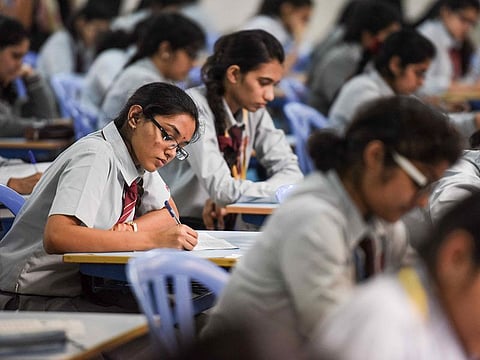
Students before their CBSE board exams at Delhi Private School centre.Photo: Virendra Saklani/Gulf News
The Central Board of Secondary Education will introduce On-Screen Marking (OSM) for Class 12 board exams from 2026, shifting from traditional physical evaluation of answer books to a fully digital system – a reform the board said is a step towards “greater accuracy and transparency”.
More than 1.8 million students appear for Class 12 exams annually. While students will continue to write their exams in physical answer books, the evaluation process will move online after scripts are scanned and uploaded onto a secure digital platform. This marks one of the most significant operational changes in recent years for India’s largest school board.
Class 10 answer books, however, will continue to be evaluated in physical mode for now.
What is changing?
Under the new system, answer books will be digitally scanned and made available to examiners through a secure portal. Evaluators will assess responses on-screen, enter marks directly into the system, and totals will be auto-calculated.
By eliminating physical movement of bundles of answer sheets to evaluation centres, CBSE aims to reduce logistical delays, minimise human errors and cut operational costs.
What it means for students
For students appearing in the 2026 Class 12 exams, the exam hall experience will remain unchanged. They will continue writing with pen and paper under existing board rules. However, the post-exam process is expected to become more streamlined.
What are the benefits
One of the biggest benefits is the elimination of totalling errors – a common reason students apply for verification of marks. Since marks will be digitally entered and automatically compiled by the system, arithmetic mistakes during tabulation are expected to disappear.
The board has indicated that “post-result verification of marks will no longer be required” as digital aggregation removes manual calculation discrepancies.
The digital process may also contribute to faster evaluation. In addition, the online system allows wider participation of evaluators, including teachers from CBSE-affiliated schools outside India. This broader pool could help distribute workload more evenly and support greater standardisation in marking.
What changes for evaluators?
For teachers and head examiners, evaluation will shift from physical marking centres to a digital platform. The system enables closer oversight, structured marking schemes and monitoring tools that can track evaluation patterns.
CBSE has already begun preparations to familiarise teachers with the platform through orientation webinars and practice sessions. Schools have also been provided dashboards to monitor participation and readiness ahead of live evaluation.
The board has emphasised that these preparatory exercises are essential to ensure smooth implementation and avoid technical disruptions when the evaluation cycle begins.
Reducing grievances
Every year, CBSE receives thousands of requests for verification or rechecking, often triggered by totalling errors or fears of unchecked answers. By integrating digital safeguards, automated tabulation and structured workflows, the board expects a significant drop in such grievances.
Beyond accuracy, the shift is also expected to reduce paper handling, storage and transportation, making the process more environmentally sustainable.
A step towards digital governance
The move to OSM aligns with CBSE’s broader efforts to modernise examination processes and incorporate technology-driven systems into school governance.
If implemented smoothly, the 2026 batch of Class 12 students will be the first to experience a digitally evaluated board examination system – a change that could redefine how India’s largest school board handles millions of answer scripts each year.
The OSM big picture:
Eliminates totalling errors
Reduces manual intervention
Enables faster evaluation
Expands teacher participation, including schools outside India
Reduces logistics time and cost
Promotes environmentally sustainable processes
No post-result verification required
عن المؤلف